
The Leverage Shift: How AI Rewired the Solo Practice

One person can now deliver what used to require a full agency. Here is how solo consultants are using AI systems, not just AI tools, to produce at scale without burning through every available hour.

There is a moment most solo consultants know well. It is late in the week, a client deliverable is due, and you are staring at a blank document wondering how you are supposed to produce something that looks like it came from a full agency. You have the expertise. You just do not have the hours.
I have been in that position more times than I care to count. Eighteen years of building remote marketing practices across four continents, and the defining tension never really changed: clients expected agency-grade output, and I was one person with a finite number of hours.
That tension is the reason I wrote No Team Required.
The book is not a guide to AI tools. There are plenty of those, and most of them are obsolete within six months. It is an operating system for independent professionals who want to use AI at depth, not at the surface level that most people experience when they try it, find it generic, and conclude it is not worth the subscription.
The surface-level experience is real. It reflects something genuine about how most people engage with these tools. They type a prompt, read the output, and either use it or delete it. The output is occasionally impressive and frequently forgettable. What they have not yet discovered is that this is an engagement problem, not a capability problem.
The shift that changes everything
The core argument in the book is simple. AI rewards a particular kind of thinking that most professionals were never trained to do. Not smarter thinking, not technical thinking.
Operator thinking.
An operator thinks in systems. When they sit down to produce a deliverable, they are not just producing that deliverable. They are designing the repeatable process that will make every similar deliverable faster and better in the future. The prompt they write today becomes the template they refine tomorrow. The context document they build for one client becomes the structure they replicate for every client.
An employee thinks in tasks. Finish the document. Send the email. Complete the audit. There is nothing wrong with this orientation inside an organisation where the systems are already built. But for a solo practitioner, it is the reason so many working hours disappear into production work that generates no lasting leverage.
The distinction looks like this:

The practical difference between these two orientations is not philosophical. It shows up in billable capacity. A practitioner who thinks in tasks builds one deliverable at a time. A practitioner who thinks in systems builds infrastructure that makes each deliverable faster than the last.
Three levels of engagement, and why most people stop at the first one
One of the most useful frameworks in the book describes three distinct ways of engaging with AI tools. Most people, even after months of use, are still operating at Level 1.
At Level 1, you use AI reactively. You ask a question, you accept what comes back, you move on. The output is inconsistent. You edit heavily or abandon it. You conclude the tool is useful for minor things but not for real client work.
At Level 2, you become directive. You invest fifteen minutes before a session in writing a proper brief. You specify the audience, the format, the constraints, the quality standard. You review the output critically and redirect when it misses. The quality improvement between Level 1 and Level 2 is dramatic, and it requires no new tools, no technical skills, and no time to implement beyond the decision to do it.
At Level 3, you build systems. You have a prompt library with tested templates for every major deliverable type. You use Claude Projects to hold client context so every session starts fully informed. You have documented workflows, not just habits. This level takes six to twelve weeks of consistent practice to build. The return is indefinite.
The majority of practitioners who describe being disappointed by AI are operating at Level 1 and drawing conclusions about what Level 3 looks like.
What actually changes when you go deep
Here is something concrete from my own practice. Before committing fully to an AI-augmented approach, a marketing audit took two to three full working days from blank page to client-ready document. Within six months of building proper workflows, that same deliverable took six to eight hours. The quality was higher. The analytical depth was greater, because the synthesis work that previously consumed hours was happening in minutes.
That shift did not come from using a better model or subscribing to a fancier tool. It came from three things: richer briefs, persistent client context in Projects, and a documented workflow refined with every engagement.
The economics compound in a way that surprised even me. When production time on a major deliverable drops by 60 percent, the freed capacity does not just make you faster. It changes what you can offer. More clients. Interactive dashboards and HTML tools that would previously have required a developer budget. Research depth that would have required a junior analyst.
The capability most solo consultants do not know they have
One of the later sections of the book covers what I call vibe coding, which is building functional software tools through natural language direction rather than writing code. For consultants without a technical background, this opens up a category of deliverable that was previously impossible without hiring a developer.
A custom ROI calculator built specifically for a client's business model. An interactive marketing performance dashboard. A content audit tool with filtering and status tracking. The first build takes a few hours. The second, using the first as a template, takes forty-five minutes.
The value to the client is significant. The value to your practice is even greater, because these tools create ongoing presence in the client's workflow in a way that a static document cannot. An interactive tool gets used repeatedly. A report gets read once.
A note on the maturity model
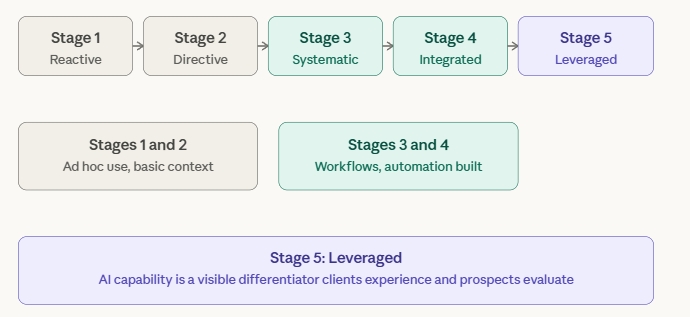
One framework practitioners find most immediately actionable is the AI Maturity Model, which describes five stages of practice development: Reactive, Directive, Systematic, Integrated, and Leveraged.
Most practitioners reading this are at Stage 1 or Stage 2. Stage 3 is where consistent quality begins. Stage 5 is where your AI capability becomes a visible competitive differentiator that clients experience directly and prospects evaluate before they engage you.
The transition from Stage 1 to Stage 2 takes one decision and one habit change. The transition from Stage 2 to Stage 3 takes four to eight weeks of dedicated infrastructure work. Each stage is specific and reachable.
Here is how the five stages map out in practice:
The honest version of where this leads
AI does not replace your judgment. It relocates it.
The strategic insight, the client relationship, the decision about what actually matters for this business in this market at this moment: that remains yours. It has always been the highest-value part of what you do. What changes is that the production burden sitting between your thinking and your deliverable shrinks dramatically.
Your expertise does not disappear when AI handles the first draft. It moves upstream. You stop being the writer of the document and start being the director, the strategist, the standard-setter. For most experienced consultants, that is not a loss. It is the most liberating professional shift they have made in years.
No Team Required is available on Amazon now. If you are a solo consultant, fractional executive, independent professional, or anyone building a practice without a large team, it was written for you.


Comments