
Is Traditional Marketing Failing in 2026? Here Is Why AI Belongs in Your 2027 Framework

Here is the uncomfortable statistic. According to SparkToro, 68% of U.S. Google searches ended without a click in early 2026. In 2024, that figure was 60%.
That is a 7.6-point rise in two years, and it is only the first crack.

Traditional marketing is failing at three jobs
Traditional marketing is failing at three jobs: getting found, earning trust, and converting demand at a sustainable cost. Search sends fewer clicks. Buyers form their shortlist before they speak to you. Acquisition costs rise while budgets stand still.
AI is the one lever that changes the economics of all three. Most teams still use it as a productivity add-on, not as a new operating model. Here is the picture for 2027:
Search: 68% of searches end without a click, and the share of searches producing any click fell 22.9% since 2024.
Budget: According to Gartner, marketing budgets average 7.8% of revenue, essentially flat, and 56% of CMOs lack the budget to deliver their 2026 strategy.
Buyers: According to 6sense, 82% of B2B buying groups choose the vendor they favored before contacting any seller.
AI value: According to McKinsey, fewer than 10% of organizations have captured AI value across their marketing workflows.
That last gap, not the technology, is the 2027 opportunity.
Search no longer delivers the click
Ranking well is no longer the same as being read. According to SparkToro, the share of searches that produce any click fell 22.9% between 2024 and 2026.
Signal | Latest reading | Source |
Zero-click share of U.S. Google searches | 68.01% (Jan to Apr 2026), up from 60.45% in 2024 | |
Searches with at least one click | Down 9.51 points, a 22.9% relative decline since 2024 | |
Searches that show an AI Overview | More than 20% | |
Click-through rate when an AI Overview appears | Nearly 60% lower | |
Position one click-through rate on AI Overview keywords | 58% lower (December 2025 data) | |
Google AI Mode reach | More than 1 billion monthly users (Google I/O 2026) |
Here is the correction to the loudest forecast. In 2024, Gartner predicted that traditional search volume would drop 25% by 2026.
The volume held. U.S. organic traffic was down about 2.5% year on year in Graphite data summarized by Digital Bloom. What fell is the return on each search.
The same query now delivers an answer on the results page. The brand that wrote the source material often gets nothing for it.
The effect is also early. Only 0.34% of searches moved into AI Mode during the SparkToro study window. Treat the 2026 figures as the starting point, not the ceiling.
Informational content is the most exposed. Branded, local, and high-intent transactional queries are less affected.
Visibility inside the answer is worth fighting for. Seer Interactive's study of 3,119 informational queries found that brands cited in an AI Overview earn a 35% higher organic click-through rate than uncited brands on the same query.
Trust has moved from brands to people like the buyer
Broadcast messaging assumes two things: a broad audience, and trust in the sender. Edelman's 2026 research challenges both.
According to the 2026 Edelman Trust Barometer (nearly 34,000 respondents, 28 countries), seven in 10 people are hesitant or unwilling to trust someone with different values, facts, or backgrounds. Trust has moved to people like me, neighbors, and coworkers.
The special report, Brand Growth in an Insular World (17,688 respondents, 15 countries, fielded April 23 to May 11, 2026), lists earned media carrying more weight than advertising among its top ten findings.
At Cannes Lions 2026, Richard Edelman argued that earned credibility now outranks paid reach, and that AI search rewards third-party validation.
Here is the implication: credibility earned from independent experts, customers, and communities serves two audiences at once, human buyers and answer engines. Paid interruption serves neither as well.
Acquisition costs rise while budgets stand still
Spending more is the traditional answer. Most leaders cannot do it.
According to Gartner's 2026 survey of 401 CMOs, budgets average 7.8% of revenue. That is up 0.1 point on 2025 and 18% below the mean of four years earlier. 56% say they lack the budget for their 2026 strategy. 54% say they lack the resources.
Spend is also flowing to the channels under the most pressure. Gartner found that awareness and conversion account for 62.6% of total media spend.
Here is what the cost data shows. These are platform and vendor benchmarks, not audited studies, but the direction is consistent:
Customer acquisition cost: Shopify's 2026 Global Commerce Report, as relayed by Zembula, shows average acquisition cost moving from $274 to $318 across 4.8 million merchants in one year. That is a 16% increase.
Two-year view: Benchmark tracking from MobiLoud, cited by Flatline, puts ecommerce acquisition cost up about 40% in two years and Google Ads cost per click up close to 13% year on year.
Paid clicks: Seer Interactive reported that paid click-through on informational queries fell 68% when an AI Overview was present. Fewer clicks at the same bid raise the effective cost of every click.
The squeeze comes from both sides. The same budget buys fewer qualified visits, and each visit costs more to convert. More spend, more keywords, and more campaigns will not close that gap.
Buyers decide before your funnel can see them
The lead-generation model assumes a buyer reveals themselves through a form fill and then gets nurtured. The 2026 B2B research describes something different. Here is what it shows:
The decision is mostly made before contact: According to 6sense's 2026 Global B2B Buyer Experience Report, buying groups choose the vendor they favored before contacting a seller 82% of the time. Vendors left off the initial shortlist have less than a 10% chance of winning.
Buyers never go dark: 96% of buyers stay current on their categories between active evaluations, so preference forms long before a purchase is scoped.
The form is a poor signal: The buyer's team initiated 82% of first vendor contacts, and only 35.2% of buyers used their own contact information on forms. Your MQL count understates and distorts real demand.
AI is the first stop, with verification afterward: According to Forrester's State of Business Buying 2026, generative AI tools were the most cited meaningful interaction for researching purchases. Buyers then check the output with a network of peers, experts, and analysts. Buying groups average 13 internal and 9 external participants.
Proof beats promises: More than 60% of buyers trial a product before buying, and after a trial 35% plan to switch to a different provider.

Do the arithmetic. If 82% of deals go to the vendor favored before contact, everything your funnel does after the form fill competes for the remaining 18%.
Most of the decision happens before you are in the room. The work that wins it happens in AI answers, peer conversations, and expert opinion, none of which a traditional funnel measures.
Why AI belongs in the 2027 framework
AI addresses all four failures above. The 2026 evidence shows both the prize and the gap.
According to McKinsey's State of AI survey (1,719 respondents, 97 countries, fielded May 4 to June 8, 2026), 89% of organizations use AI in at least one function and 44% are scaling it across the enterprise. Revenue gains are most often attributed to AI in marketing and sales.
Marketing shows the execution gap. McKinsey's June 2026 marketing research found that 60% of marketers use AI several times a week, but only 28% are rewiring their teams and workflows. That is a 32-point gap between using AI and redesigning around it. Fewer than 10% of organizations have captured value across marketing workflows.
Gartner reports the same split from the CMO side. 70% call AI leadership a critical 2026 goal, and only 30% have mature readiness. AI-ready teams put 21.3% of their marketing budget into AI and hold budgets of 8.9% of revenue, against the 7.8% average.

Adoption is not redesign.
Where teams do redesign marketing around AI, McKinsey reports two to three times the productivity, 10% to 30% in savings, and 4% to 7% growth in revenue and conversion value. Up to $90 billion in improved marketing returns is available in the U.S. alone.
These are consultancy estimates developed with Google. Treat them as the upper range, not a forecast for any single team. Here is how AI maps to each failure:
2026 failure | What AI changes | Evidence |
Search clicks are disappearing | Visibility inside answer engines becomes a managed channel, not a side effect of SEO | McKinsey expects $750 billion of consumer spend to flow through AI-powered search by 2028. Adobe measured U.S. retail traffic from AI sources up 393% year on year in Q1 2026, converting 42% better with 37% higher revenue per visit in March |
Trust sits with peers, not ads | Relevance at scale: tailored content for specific communities, and signals that show where credibility is earned | McKinsey cites personalization lifting revenue 5% to 8% and customer satisfaction 15% to 20% |
Costs rise, budgets do not | Always-on optimization and faster production lower cost per outcome | McKinsey cites creative cycles cut from 6 to 10 weeks to same-day, and execution time falling from 60% to 70% of marketers' effort to 10% to 15% |
Buyers decide before contact | Continuous customer signals, persona simulation and monitoring of how AI describes your brand | Forrester finds generative AI is the most cited research interaction; 6sense finds shortlists are fixed early |
Two analyst signals point to 2027 as the planning year. Gartner's Hype Cycle for Digital Marketing, 2026, published July 10, 2026, describes a CMO trilemma of flat budgets, high growth demands, and disruptive answer engines. It positions autonomous marketing as the operating model forming in response.
Gartner's Digital Commerce Hype Cycle adds that agent-driven commerce now occupies many of the most influential positions, with Answer Engine Optimization emerging as a discipline of its own.
Build a five-layer framework for 2027
Here is the structure I recommend, built on the evidence above. Each layer answers one of the 2026 failures, names an owner, and carries a metric your CFO can audit.
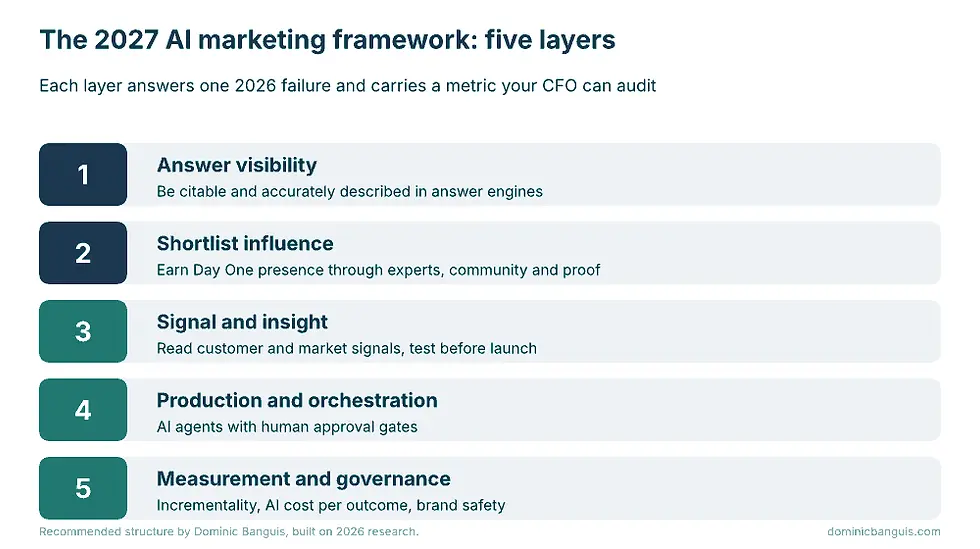
Layer | What it does | Owner | Metrics to track |
1. Answer visibility | Makes the brand citable and accurately described in answer engines through factual, structured pages and third-party mentions | Content, PR, SEO | Citation share on a fixed set of buyer prompts; AI referral sessions and conversion rate; branded search trend |
2. Shortlist influence | Earns Day One shortlist presence through expert voices, community, customer proof and trials before sales contact | Brand, product marketing, community | Win rate when first choice; share of first contacts initiated by the buyer's team; shortlist mentions in win and loss interviews |
3. Signal and insight | Uses AI to read customer, market and channel signals and to test messaging on simulated personas before launch | Marketing operations, insights | Days from signal to decision; tests run per month |
4. Production and orchestration | Uses AI agents to draft, adapt and route work, with human approval gates | Marketing operations, creative | Campaign cycle time; cost per asset; share of workflows redesigned, not just assisted |
5. Measurement and governance | Replaces last-click credit with incrementality and media mix testing, and sets cost, brand safety and audit rules for AI | Marketing with finance | Incremental acquisition cost; AI cost per outcome; error and rework rate |
Here are five moves for the first two quarters of 2027:
Baseline answer visibility. Run 50 to 100 realistic buyer prompts across ChatGPT, Gemini, Google AI Mode and Claude, and record whether your brand is cited and described correctly.
Rewire two workflows, not twenty. Pick two high-volume workflows, such as content production and performance reporting, and redesign them end to end. McKinsey's 28% rewiring figure shows this is where most teams stall.
Fund it from existing spend. Budgets are flat, so reallocate. Gartner's 21.3% allocation among AI-ready teams is a benchmark to size against, not a target to copy.
Fix the measurement. Add incrementality tests, and ask new customers how they first heard of you, because the dark funnel will not appear in click data.
Set governance before scale. Define approval rules, spending caps and brand safety checks first. Gartner's 2026 Hype Cycle frames AI spend as a governance problem as much as a tooling choice.
Know the limits before you scale
The case for AI is strong, but it is not unconditional. Here are five limits to build into your 2027 plan:
Adoption outruns value: Only 37% of respondents in McKinsey's State of AI survey report a positive EBIT impact from AI, unchanged from 2025. In a TransUnion study of 100 senior U.S. marketers, only 53% reported meaningful ROI from AI-driven marketing, and 65% measured impact mainly through estimated cost or time savings.
Agents are still early: BCG's 2026 CMO survey classed only 32% of CMOs as deploying AI agents across meaningful workflows. 42% are at risk of pilots that never scale.
AI has its own cost curve: About one in five McKinsey respondents say AI operating costs, including token costs, constrained their AI use.
Accuracy and trust are open questions: In Forrester's data, 20% of buyers felt less confident in a decision because of unreliable AI information. Buyers verify AI output with people, so the claims AI repeats about your brand must be accurate and consistent.
The people problem is real: According to McKinsey, 80% of CMOs think AI could put their own role at risk. Marketers also believe the C-suite values AI for productivity, while 53% of marketers value it more for growth. Without a shared case with finance, your AI budget stays small.
The measurement caveat applies to the AI channel itself. Referral traffic from AI tools is growing quickly from a small base, and AI Mode was only 0.34% of searches in SparkToro's window. Plan for the trajectory, and judge each investment on measured outcomes.
Bottom line
Traditional marketing is not dead. Brand building, strong sales relationships, and well-run owned channels still work. What is failing is the set of mechanics built on rented clicks, interruption, and last-click credit.
For 2027, the question is not whether to use AI. Nearly everyone does. The question is whether you will redesign marketing around it: answer visibility, shortlist influence, and measured cost per outcome, not more campaigns on a shrinking click.
I go deeper on building an AI-first marketing operating model in The AI CMO Playbook, available on Amazon KDP.
Dominic Banguis is a Fractional CMO and AI Systems Builder at GrowthBoxx, working with startup, SaaS, fintech, and ecommerce clients across Southeast Asia, the UK, and Europe. Learn more at dominicbanguis.com.
Sources
Figures reflect the data available at the time of writing, November 11, 2026.
Core research:
Search and AI visibility:
Trust and buyer behavior:
Economics and AI adoption:


Comments